
Most people describe themselves with personality traits.
I’ve always found that a little limiting.
So instead, I started wondering:
If my life were a company, what kind of company would I want it to be?
Not in the sense of “I’m like this company,”
but in the sense of:
What philosophy, culture, and operating system would I choose if I could design them from scratch?
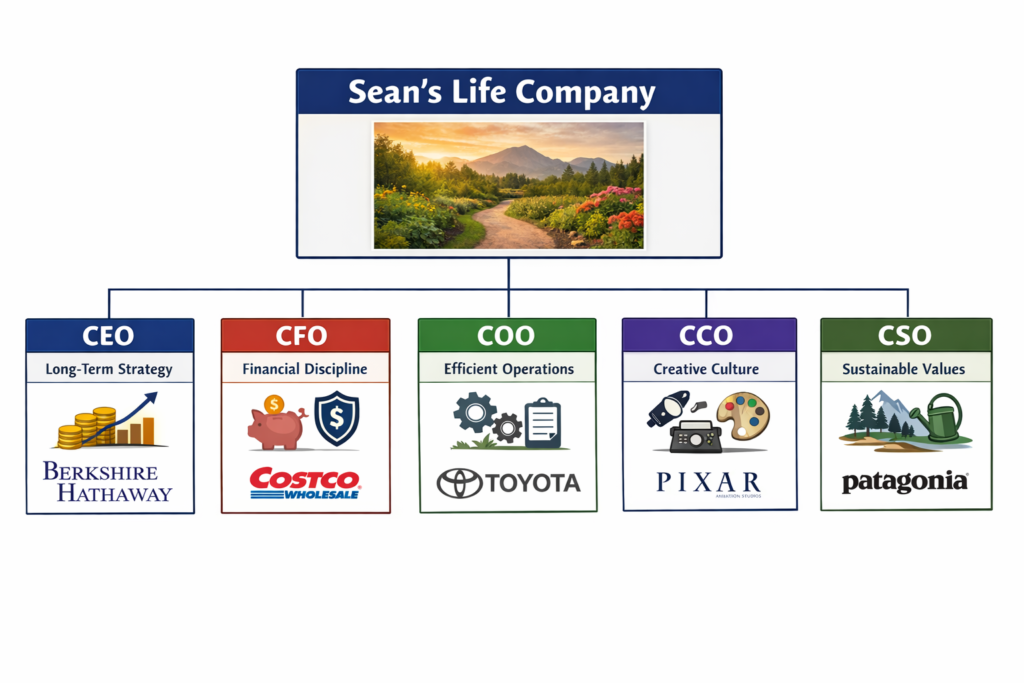
It turns out the answer isn’t one company —
it’s a small, carefully chosen executive team.
- A CEO like Berkshire Hathaway
- A CFO like Costco
- A COO like Toyota
- A CCO like Pixar
- A sustainability lead like Patagonia
This isn’t about comparison.
It’s about design —
a quiet blueprint for how I want to live.
The CEO: Think in Decades, Not Days
If my life had a CEO, it would think like Berkshire Hathaway.
Not reacting to noise.
Not chasing trends.
Not optimizing for this quarter.
Just patiently allocating time, energy, and attention toward things that compound.
In real life, this looks like:
- letting good decisions play out over years
- accepting that boredom is often a sign of correctness
- resisting the urge to constantly “do something”
Don’t interrupt compounding — most mistakes come from trying to help too much.
The CFO: Spend Carefully, But Without Fear
Costco is one of the most disciplined companies in the world —
and also one of the most generous.
Low margins.
High trust.
Extreme consistency.
That balance matters.
In life, financial discipline isn’t about restriction.
It’s about alignment:
- spend heavily on what truly matters
- be ruthlessly efficient on what doesn’t
- keep systems simple enough to sustain for decades
Not frugality for its own sake.
Not indulgence for its own sake.
Just clarity.
The COO: Build Systems That Don’t Break
Toyota doesn’t rely on heroic effort.
It relies on systems.
Small improvements.
Repeated consistently.
Over a very long time.
That idea translates directly into life:
- health is not intensity — it’s consistency
- work is not bursts — it’s rhythm
- progress is not dramatic — it’s incremental
A short walk after meals, a consistent rhythm to the day — small systems that don’t look impressive, but quietly hold everything together.
The best systems remove the need for discipline.
The CCO: Stay Curious, Not Just Productive
Pixar doesn’t optimize for output.
It protects creativity.
That’s rare — and increasingly valuable.
In a world that rewards speed and volume, creativity requires space:
- time to observe
- time to think
- time to do something with no immediate payoff
For me, that shows up in photography, writing, gardening, and quiet exploration — the small creative rituals that make a day feel alive.
Not everything needs to scale.
Some things just need to matter.
The Sustainability Lead: Know What Is Enough
Patagonia operates with a different question than most companies:
Not “How do we grow faster?”
but “How do we grow responsibly?”
That shift is subtle — but profound.
In life, this becomes:
- defining what “enough” looks like
- resisting unnecessary expansion
- protecting what already works
Because without a sense of “enough,”
everything turns into optimization.
And optimization, unchecked, becomes exhaustion.
The Operating System: How It All Works Together
But an executive team alone isn’t enough.
What really determines how a company runs — and how a life unfolds — is its operating system.
A set of quiet rules that guide decisions when no one is watching.
- Default to long-term thinking
- Keep systems simple
- Build repeatable habits
- Protect creative space
- Define what “enough” means
You don’t see the system directly.
But you feel it in everyday choices:
- choosing a walk instead of more work
- letting investments sit instead of constantly adjusting
- writing something thoughtful instead of chasing attention
Design the system once.
Adjust it slowly.
And let it compound.
The Board of Directors: Quiet Alignment
When all these pieces work together, something changes.
There’s less internal conflict.
Less second-guessing.
Less urgency without direction.
Decisions feel quieter.
Not easier — but clearer.
Because they’re guided by principles, not impulses.
Final Thought: A Company That Doesn’t Need to Scale
The goal of most companies is growth.
But the goal of a life might be different.
Not maximum scale.
Not maximum output.
Just:
- stability
- meaning
- freedom
- and enough room to think
If my life were a company,
I wouldn’t want it to be the biggest.
I’d want it to be:
well-run, quietly profitable, and built to last.
Maybe that’s the real idea:
Not to become like any one company —
but to choose your own operating system.
And then let it compound.
If your life were a company, who would you choose for your executive team?