
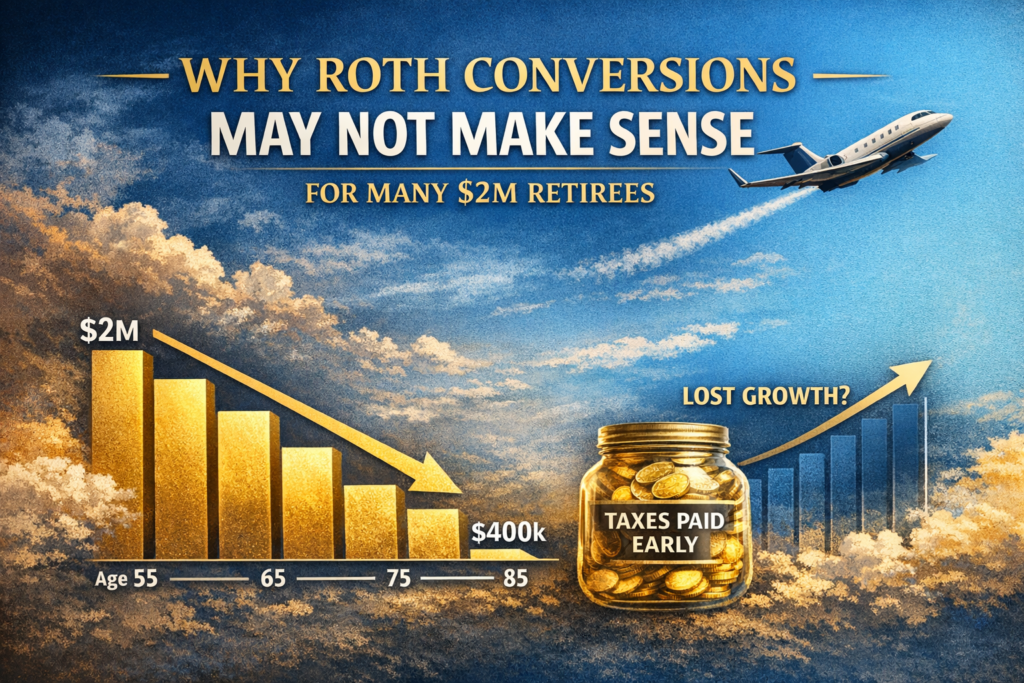
What happens if you simply invest the taxes instead?
A Question That Made Me Pause
Recently I started thinking more seriously about Roth conversions.
A Roth conversion requires paying taxes today in order to reduce taxes in the future. The idea is simple: move money from a traditional retirement account into a Roth account now, pay the tax today, and avoid taxes later.
But a question kept nagging at me:
What if I simply invested the taxes instead?
If someone converts aggressively for 10–15 years, they might pay tens of thousands of dollars in additional taxes each year. Over time, those taxes can easily add up to hundreds of thousands of dollars, leaving the portfolio.
What if those tax dollars had stayed invested instead?
Would the compounded growth of that money offset the future taxes from Required Minimum Distributions?
Most retirement advice assumes you want to optimize taxes over a 40-year horizon, but many retirees simply want to enjoy their money and avoid unnecessary complexity.
Of course, the future is uncertain. Tax laws may change, investment returns will vary, and no one knows exactly how long they will live. But thinking through the trade-offs still reveals something interesting.
For a large group of retirees, Roth conversions may not provide the benefit that many financial articles suggest.
The Scenario: $2M Pretax at Age 55
Consider a fairly common early-retirement scenario:
Age: 55
Retirement savings: $2 million in a traditional IRA or 401(k)
Annual spending: $100k–$120k
Plan: intentionally spend the money during retirement
Life expectancy: roughly age 85
No strong goal to leave a large inheritance
This profile is more common than many people realize.
But it is not the ideal Roth conversion candidate.
Many Roth conversion discussions assume the portfolio will continue growing indefinitely. But if withdrawals roughly match or exceed investment growth, the tax problem often solves itself over time.
1. The Pretax Balance Naturally Declines
If someone withdraws $100k–$120k annually, the retirement balance will likely decline over time even with moderate returns.
A simplified example might look like this:
Age — Approximate Balance
55 — $2.0M
65 — ~$1.6M
75 — ~$1.1M
85 — ~$300k–$500k
This is not a massive tax bomb waiting to happen.
Under current law, Required Minimum Distributions generally begin between ages 73 and 75 depending on birth year.
If the balance is around $1.1M at age 75, the first RMD might be roughly:
$1.1M ÷ 24.6 ≈ $45k
That’s a relatively modest withdrawal — unlikely to trigger huge tax brackets or the kind of tax explosion many people fear.
2. The Future Tax Bracket May Be Lower
Many retirees withdrawing $100k–$120k annually end up in moderate tax brackets:
12–22% federal
Possibly 24% in some years
Lower state taxes if relocating
If someone converts today at 24% or higher, they may actually be pre-paying taxes at a higher rate than they would pay later.
That reverses the core logic behind Roth conversions.
3. Roth Conversions Benefit Long Lifespans
Roth conversions tend to work best when the converted money stays invested for a very long time.
In many models, the break-even point occurs decades later — sometimes well into the 90s.
If someone plans for a lifespan to around age 85, the window for Roth advantages becomes much smaller:
Only about 10 years of RMD avoidance
The upfront tax cost may never fully recover
Shorter investment horizons weaken the case for conversions.
4. Paying Taxes Early Reduces Compounding
This was the question that started my curiosity.
Every dollar paid in tax today is a dollar that no longer compounds.
If someone pays:
$20k–$40k extra tax per year
for 10–15 years
That could mean $200k–$400k removed from the portfolio.
To illustrate the scale, imagine someone paying $24k per year in extra tax during a 10-year conversion strategy.
That’s about $240k in taxes paid early.
If that $240k had remained invested and earned a 6% annual return for 25 years, it could grow to roughly:
$240k → about $1 million
That compounding effect is significant.
Of course, the comparison isn’t perfectly symmetrical because Roth accounts also grow tax-free — but the lost compounding of taxes paid early is still an important part of the trade-off.
In other words, the decision isn’t just tax today versus tax tomorrow.
It’s also compounding versus prepaying tax.
5. Inheritance Benefits May Be Limited
Roth conversions can be very helpful for estate planning.
But if the retiree intends to spend most of the portfolio during their lifetime, the inheritance advantage becomes much smaller.
If the remaining balance at death is modest:
heirs are unlikely to face a large tax burden
the 10-year withdrawal rule becomes less significant
the tax planning value of Roth conversions declines
A Missing Piece: What If Lifespan Is Uncertain and the Balance Is Large?
There is one group for whom the Roth conversion story looks very different: retirees with large pretax balances, low spending, and strong investment growth.
For these individuals, the regret curve is asymmetric.
If they convert and happen to live a shorter life than expected, the regret is usually small. They paid some tax early, but their heirs avoid paying much higher rates later, and the Roth money continues compounding tax-free.
But if they don’t convert and instead live longer than expected, the regret can be substantial. Large pretax balances can grow faster than withdrawals, leading to very high Required Minimum Distributions, higher tax brackets later in life, Medicare surcharges, and a significant tax burden for heirs under the 10-year withdrawal rule.
In other words, for retirees with large and growing pretax accounts, the bigger regret often comes from not converting — especially if they live into their 90s.
This is the opposite of the $2M-at-55 scenario, and it highlights why Roth conversions are not one-size-fits-all.
Who This Article Is For
This article is written for retirees who fit a profile like:
Around $2M pretax at age 55
Planning to spend $100k–$120k per year
Expecting a lifespan to around 80–85
No strong desire to leave a large inheritance
Comfortable letting the pretax balance decline naturally
Not facing massive RMDs later in life
For this group, Roth conversions often don’t provide a dramatic benefit.
Who This Article Is Not For
This article is not aimed at people who have:
Large and growing pretax balances
Low spending relative to portfolio size
A desire to minimize taxes for heirs
A high likelihood of living into their 90s
A strong estate-planning focus
High-income heirs who would face very high tax rates on inherited IRAs
A portfolio that grows faster than withdrawals
For these individuals, the regret curve is different.
The bigger regret often comes from not converting — especially if they live longer than expected.
When Roth Conversions Do Make Sense
None of this means Roth conversions are bad.
They can be extremely powerful in certain situations, such as:
Very large traditional IRA balances
Very low taxable income early in retirement
Strong estate planning goals
Long investment horizons
But the key point is simple:
Roth conversions are not universal.
A More Nuanced View
For someone with:
$2M pretax at 55
$100k–$120k annual withdrawals
a plan to spend most of their savings by 85
no large inheritance goal
Roth conversions may not dramatically improve their financial outcome.
Their pretax balance declines naturally.
Their RMDs remain manageable.
And paying taxes early may reduce the compounding power of their portfolio.
And beneath all the math sits a simple truth:
Nothing in retirement planning is certain. You make the best decision you can with the life you expect to live, knowing the goal isn’t perfection — it’s reducing future regret and aligning your money with your values.
In the end, retirement planning isn’t about winning a tax simulation.
It’s about matching your money to your life.
For some people, that means converting aggressively.
For others, it means spending confidently and letting the pretax balance shrink naturally.
The key is knowing which path fits your actual life — not simply following the generic advice you see online.
Related Reading
Should You Worry About the Tax Bomb?
A deeper look at why pretax growth isn’t a problem — and how to use it as a conversion reservoir.