
How one generic cough medication quietly taught me a useful life skill
I used to assume that once insurance was involved, prescription pricing would be mostly standardized.
Same insurance card. Same medication. Same copay.
That seemed logical enough.
But this week, a simple cough medication showed me that the system behaves very differently from what many of us imagine.
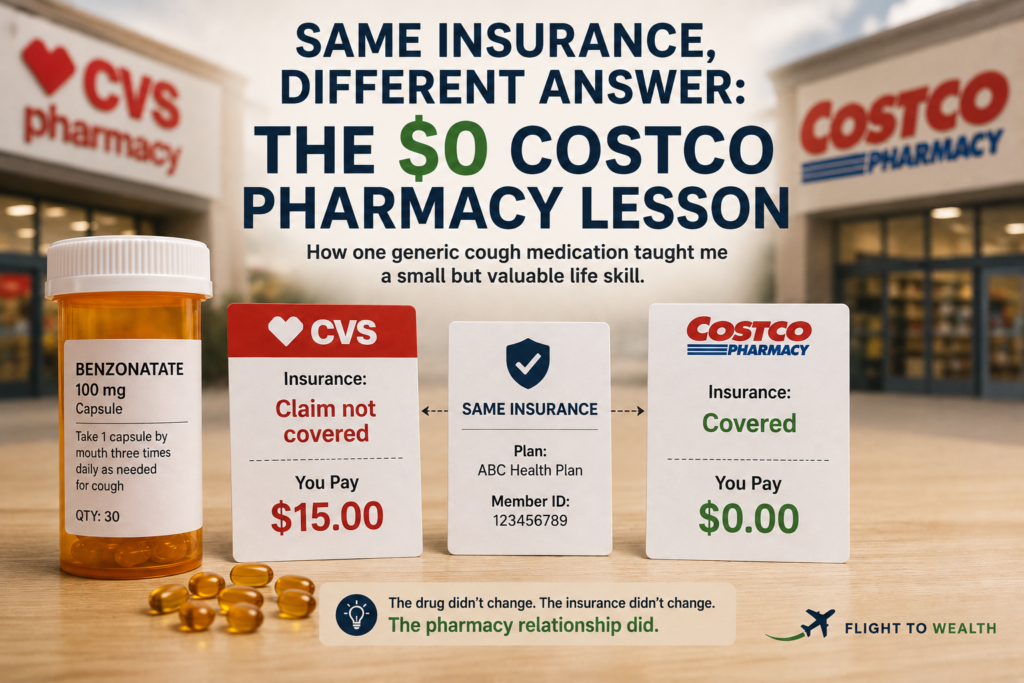
I recently filled a prescription for benzonatate, a generic medication for dry cough. At CVS, I was told insurance did not cover it, so I paid around fifteen dollars out of pocket. Not terrible, but enough to notice.
A few days later, I transferred the prescription to Costco.
Same medication. Same dosage. Same insurance.
This time the pharmacist looked up my account, scanned the insurance, and said:
“You’re all set. No copay today.”
Zero dollars.
For a second, I honestly thought I heard it wrong.
What surprised me was not simply that Costco was cheaper. I already knew Costco often had lower prices on many things.
What surprised me was that the exact same insurance produced a completely different outcome depending on the pharmacy.
At CVS, the medication behaved like it was not covered.
At Costco, it behaved like a covered prescription.
That contradiction stayed in my head the rest of the day.
I started reading more about how pharmacy pricing works and realized the system is far more fragmented than I had assumed. Prescription pricing is not determined only by the insurance company. It also depends on the pharmacy, negotiated contracts, pharmacy benefit managers, pricing agreements, and preferred pharmacy networks.
In other words, “not covered” does not always mean the medication itself is universally uncovered everywhere.
Sometimes it means the relationship between that pharmacy and the insurance system produced a different result.
The drug didn’t change.
The insurance didn’t change.
The pharmacy relationship did.
That was the real lesson for me.
Afterward, I discovered that many other people have noticed similar patterns with Costco Pharmacy. A number of consumer articles and online discussions describe Costco as having lower pricing and more favorable outcomes for generic medications, while CVS tends to win more on convenience and store availability.
Some people reported saving only a few dollars. Others reported much larger differences.
I also learned something I did not know before: you do not need a Costco membership to use the pharmacy in many states, although members may receive additional discounts.
None of this means CVS is “bad” or Costco is magically generous. They are simply operating under different pricing structures and insurance relationships. From the customer side, though, the experience can feel surprisingly inconsistent.
And that inconsistency itself becomes useful knowledge.
The practical lesson I took away is simple: if a generic medication suddenly seems expensive or “not covered,” it may be worth checking another pharmacy before accepting the first answer.
Especially Costco.
This experience reminded me of something broader that shows up repeatedly in life and finance.
Many systems look uniform from the outside but behave very differently underneath. Taxes work that way. Banking works that way. Investing works that way. Healthcare definitely works that way.
The people who slowly learn these small asymmetries — and quietly adapt to them — often accumulate advantages over time without making dramatic changes.
Sometimes the lesson comes from a spreadsheet.
Sometimes it comes from a book.
And sometimes it comes from hearing the words:
“No copay today.”