
Six Months Later: Seeing the Philosophy in Action
Disclosure: This article reflects my personal investing journal and is not investment advice. All investments involve risk, including the possible loss of principal.
Six months have passed since my Satellite Portfolio Update – January 2026. In that article, I explained why I renamed the portfolio from “Moonshot” to “Satellite.” The change reflected a deeper evolution in my investing mindset. Instead of constantly searching for the next exciting, high-flying stock, I wanted a portfolio that could deliberately complement my long-term index investments—built around durable businesses, selective asymmetric opportunities, and patience.
At the time, it was simply an investment philosophy written down on a page. Today, I can finally look back and ask a simple question: Has it worked? For me, the answer is yes, although the journey included both successes and disappointments.
Performance Snapshot
Since launching the portfolio in June 2025, the returns have been highly encouraging. The return since inception stands at +33.6%, with a 2026 Year-to-Date return of +23.5%.
Crucially, these returns weren’t driven by a rising tide lifting every position uniformly. Instead, a handful of outstanding winners more than offset several disappointing investments. This stark asymmetry is exactly what I hoped the portfolio would achieve when I designed the framework.
Portfolio Journey
| Period | Key Milestone | Return |
|---|---|---|
| Jun–Dec 2025 | Portfolio established | +18.5% |
| Jan–Apr 2026 | Market correction | −2.1% |
| May–Jun | Continued accumulation | +2.2% |
| Late June | Portfolio recovery | +3.3% |
| Jul 1–7 | CRNX acquisition | +19.1% |
> Note: Additional contributions were made throughout the journey. These returns are tracked using my personal portfolio methodology and are intended to document the evolution of the portfolio rather than serve as a formal performance benchmark.
The January Vision Is Becoming Reality
Back in January, I wrote that the Satellite Portfolio would emphasize gradually building positions in durable businesses, maintaining lower portfolio turnover, allowing winners to run longer, and systematically reducing exposure to the riskiest ideas over time. Looking back, I realized those principles quietly influenced almost every decision I made this year. Instead of constantly hunting for brand-new ideas, I found myself doubling down and strengthening positions in businesses I have grown increasingly confident in: Microsoft, Costco, Visa, JPMorgan Chase, AbbVie, and Qualcomm.
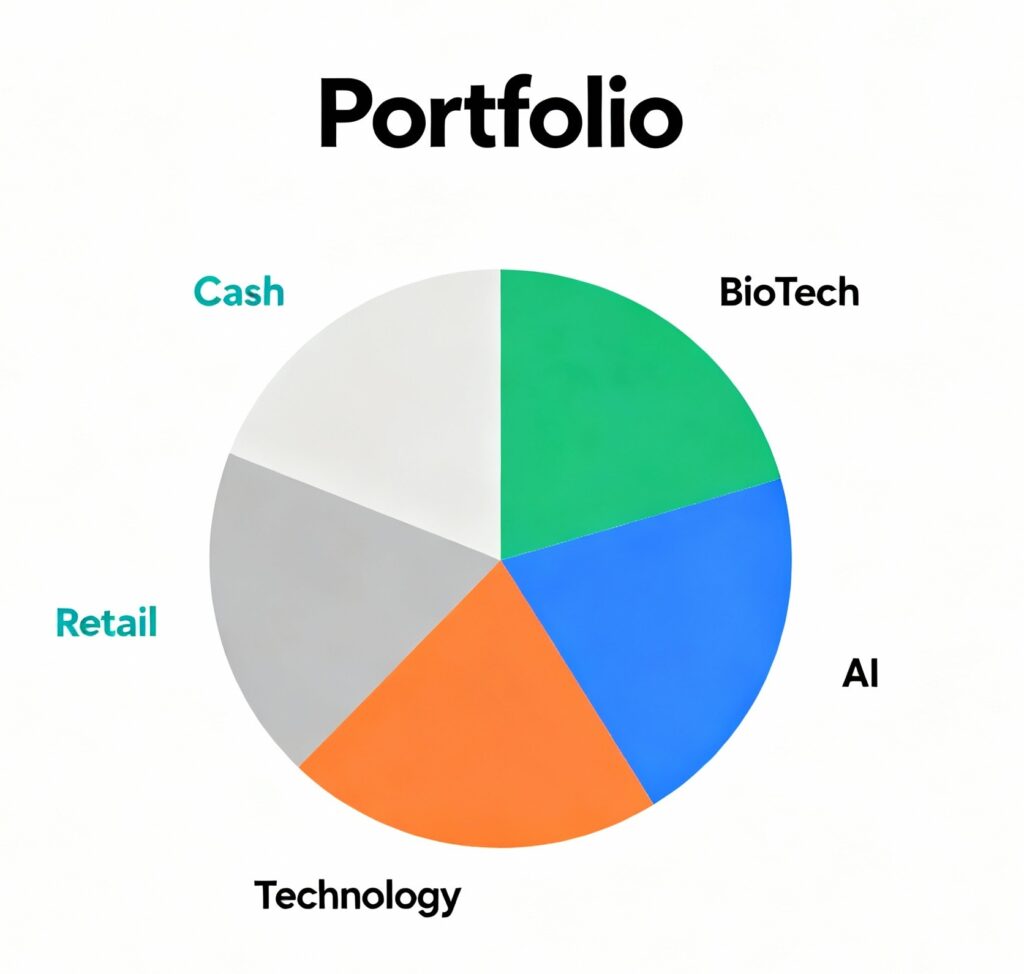
Alongside these core holdings remained a smaller, deliberate collection of higher-upside opportunities, including Crinetics Pharmaceuticals, Viking Therapeutics, STMicroelectronics, SpaceX (SPCX), and Aeva Technologies. Without consciously planning it, the portfolio naturally evolved into a structured framework I now think of as Core + Asymmetry.
Portfolio Snapshot Immediately Before the CRNX Sale
| Holding | Role | Approx. Weight | Status |
|---|---|---|---|
| Crinetics Pharmaceuticals (CRNX) | Asymmetric Biotech | ~28% | Sold following acquisition (+150%+) |
| Costco (COST) | Core Compounder | ~11% | Long-term holding |
| STMicroelectronics (STM) | Asymmetric Growth | ~8% | Multi-bagger (+160%+) |
| Microsoft (MSFT) | Core Compounder | ~8% | Continuing to build |
| ServiceNow (NOW) | Growth Compounder | ~7% | Recovering |
| Visa (V) | Core Compounder | ~5% | Long-term holding |
| JPMorgan Chase (JPM) | Core Financial | ~5% | Long-term holding |
| Viking Therapeutics (VKTX) | Asymmetric Biotech | ~5% | High-conviction growth |
| SpaceX (SPCX) | Asymmetric Growth | ~4% | Early position |
| AbbVie (ABBV) | Dividend Growth | ~3% | Long-term holding |
| Qualcomm (QCOM) | Core Compounder | ~2% | Recently added during weakness |
| Smaller Positions (AEVA, TEAM, VNET, ROOT, AI, SLDP, SNWV) | Optionality | ~4% | Mixed results |
| Cash | Dry Powder | ~10% | Ready for future opportunities |
The CRNX Story
CRNX became the defining investment of the portfolio’s first year, not merely because it was acquired, but because it perfectly demonstrated the exact type of opportunity I hope to identify. I didn’t buy CRNX because I expected a quick takeover; I bought it because I believed it had the fundamentals to become a highly successful, independent biotechnology company. Several factors originally stood out to me: a promising multiple-drug endocrine pipeline, management’s tangible confidence in the commercial launch of Palsonify (paltusotine), and a strong balance sheet capable of supporting continued clinical development.
As broader biotech sentiment weakened over the past year, I chose to continue adding to the position instead of abandoning my original thesis. In fact, one of my favorite purchases came near $33 only weeks before Vertex announced its acquisition. The acquisition wasn’t part of my explicit thesis—it simply accelerated the ultimate realization of it.
Buying, however, is only half the story, and selling deserves just as much discipline. Once Vertex agreed to acquire CRNX, I believed the original investment thesis had largely played out. The remaining upside appeared modest compared with the flexibility gained by holding cash and waiting for future opportunities. Rather than waiting months for the transaction to formally close, I chose to sell my Roth IRA position shortly after the announcement. For me, this wasn’t about squeezing out every last dollar; it was about recognizing when an investment had reached its natural, logical conclusion.
The Value of Owning Around Twenty Companies
One realization that genuinely surprised me this year is that I actually enjoy owning around twenty carefully selected businesses. This preference isn’t driven by a desire to own more stocks for the sake of it, but rather because I want more high-quality options. Because every company in the portfolio has already passed my initial research process, I don’t need to start researching from scratch when the market turns sour on a specific sector. I simply revisit a business I already deeply understand.
That dynamic happened repeatedly over the past year. I quietly added to CRNX, Viking Therapeutics, Microsoft, Qualcomm, and Costco during pullbacks. Almost every meaningful purchase I made happened after periods of distinct weakness rather than periods of market excitement. The market continually creates temporary pockets of pessimism. I rarely know in advance where the next opportunity will appear, but owning a curated portfolio means I don’t have to search for ideas from scratch every time volatility returns.
Risk Management & Lessons Learned
One lesson I’ve solidified is that risk management isn’t about avoiding short-term volatility—it’s about ensuring no single mistake permanently damages your long-term wealth accumulation. My approach is fairly simple: build positions gradually, keep broad-market index funds as the unshakeable foundation of my overall strategy, and balance stable compounders with a smaller, controlled allocation to asymmetric opportunities. Ironically, adopting this framework makes market corrections easier to welcome rather than fear.
No portfolio is perfect, nor should it be. While my strongest contributors so far have been CRNX, STMicroelectronics, and Viking Therapeutics, positions such as ServiceNow, Atlassian (TEAM), Solid Power, and C3.ai have served as healthy reminders that investing always involves fundamental uncertainty. Some have struggled because market sentiment shifted, while others simply haven’t performed operationally as I originally expected. Fortunately, proper position sizing handles this automatically. The portfolio never required every single investment to succeed, as a few exceptional winners have more than compensated for the disappointments.
Looking Ahead
The CRNX acquisition marks the completion of the portfolio’s first full investment cycle and begins a brand-new chapter. For now, I’m entirely comfortable holding more cash than usual and feel no rush to put it to work. If the past year has taught me anything, it’s that patience often creates far better opportunities than constant, frantic activity. The next opportunity may come from an existing holding or from a business I haven’t even discovered yet. Either way, I’d rather be prepared than impatient.
Looking back, I don’t think the biggest success of the past year was the gain from CRNX. The bigger success was discovering that the philosophy I introduced in January genuinely fits my personality as an investor. I enjoy researching businesses, buying patiently during periods of weakness, holding quality companies for years, and allowing successful investments to compound quietly.
Broad-market index funds remain the absolute foundation of my path toward financial independence. The Satellite Portfolio exists for a different purpose: to continue learning, refining my investment process, and occasionally benefiting from unique opportunities the market temporarily overlooks. If the framework itself is proving this worthwhile, the journey is already a success.
“Great investing isn’t about finding a new idea every month. It’s about recognizing when a business you already understand temporarily goes on sale—and having both the patience and the discipline to act.”
This article continues my Satellite Portfolio Journal, where I document both portfolio performance and the evolution of my investing framework. To read the previous update: ➡️ Satellite Portfolio Update – January 2026