
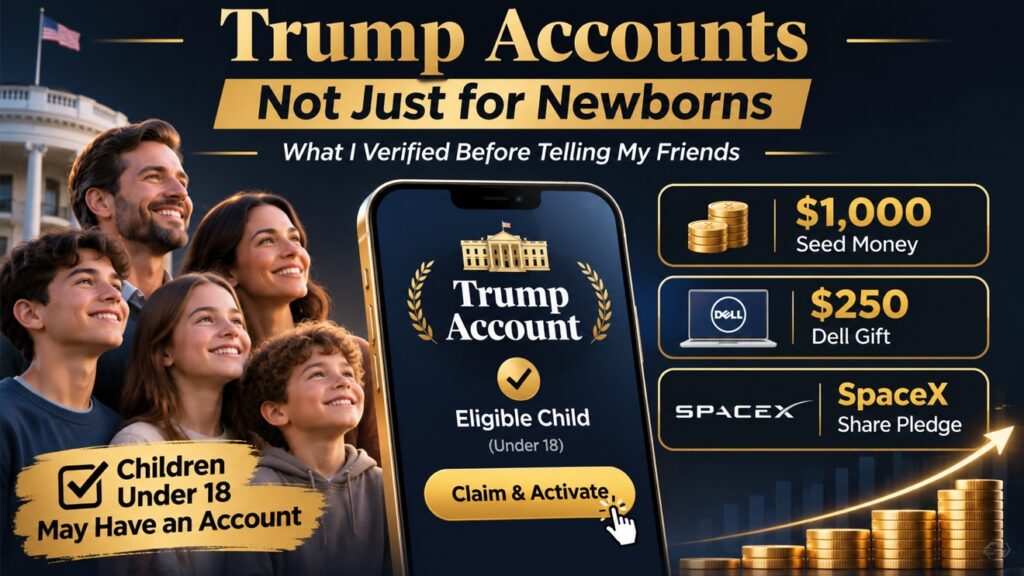
A post going around this week claimed that Trump Accounts are not just for newborns — that any child under 18 can have one, and that the accounts could bring a child free money from the government, a $250 donation from Michael and Susan Dell, and even shares of SpaceX.
It sounded like the kind of thing that gets exaggerated on social media, so before I passed it along to friends with kids, I checked it against the IRS, the Treasury’s regulations, and the organizations actually moving the money. Most of it turned out to be true — with fine print that matters, and one pleasant surprise: some of the money may already be sitting in your child’s account. Here is what I found.
First, what a Trump Account is
Trump Accounts were created by the One Big Beautiful Bill Act in 2025. They are a special kind of traditional IRA for children — a starter retirement account that a child does not need earned income to receive.
- Children with a valid Social Security number who will still be under 18 at the end of the calendar year are eligible. The child is the account’s owner and beneficiary, and each child can have only one.
- Parents, grandparents, family, and friends contribute with after-tax dollars, which are not tax-deductible. Qualifying employer contributions of up to $2,500 can be excluded from the employee’s taxable income. Both count toward the combined $5,000 annual limit per child. The government’s $1,000 and qualifying charitable gifts (below) do not count against that limit.
- During what the IRS calls the growth period — until December 31 of the year the child turns 17 — the money must be invested in diversified U.S. stock index funds. The default is a low-cost S&P 500 ETF. You cannot pick individual stocks with your own contributions.
- Ordinary withdrawals are prohibited during the growth period, with limited statutory exceptions (certain rollovers, excess contributions, and death). From January 1 of the year the child turns 18, the account is generally treated like a regular traditional IRA.
The step most people are missing: claim the account
Under Treasury regulations issued this fall, the government automatically created accounts for about 60 million eligible children on October 1, 2026. Your child very likely already has one, whether you asked for it or not.
Here is the part that surprised me: an unclaimed account is not an empty shell. It can already receive the federal contribution and qualifying donations from governments and charities — the Dell money below landed in accounts exactly this way. What an unclaimed account cannot receive is money from family, friends, and employers. For that, a parent or legal guardian must first claim the account through the official website, trumpaccounts.gov, or the official app linked from that site.
Claiming is also how you can see what’s already in there. It costs nothing and takes a few minutes.
One warning worth repeating: with tens of millions of accounts and a viral news cycle, fake “Trump Account” apps and websites are a predictable scam. Only use trumpaccounts.gov and the official app it points to.
Pot #1: The $1,000 from the government — newborns only
This is the part the headlines usually lead with, and it is also the narrowest:
- A one-time $1,000 contribution from the U.S. Treasury
- Only for children who are U.S. citizens born between January 1, 2025, and December 31, 2028
- A separate election is required — claiming the account alone does not trigger it; you elect the pilot contribution in the app, on the website, or with IRS Form 4547
If your child or grandchild was born before 2025, this pot is not available. That is exactly the gap the next two pots aim at.
Pot #2: The Dell donation — $250 that may already be in the account
Michael and Susan Dell committed $6.25 billion to put $250 into the Trump Accounts of 25 million children who miss the federal $1,000. When the gift was first announced, it was described as going to children in families earning under $150,000. The final rules, set by Invest America, which administers the gift, turned out differently — and narrower:
- Children born between January 1, 2016, and December 31, 2024
- Living in a ZIP code with a median family income of $117,300 or less, using the Census Bureau’s 2020–2024 American Community Survey data (children on U.S. military bases were also included)
Two things about this deserve emphasis, because they are widely misunderstood:
It is based on your ZIP code, not your income. Contributions started with the lowest-income ZIP codes and expanded until 25 million children were reached — which is where the $117,300 cutoff came from. A family earning $200,000 in a qualifying ZIP code got the $250; a family earning $60,000 in a higher-income ZIP code did not.
The money has already been deposited. The Dell contributions went in between August 31 and October 9, 2026, and the full allocation has been distributed. So this is not something to apply for — it is something to check for. Claim your child’s account and look at the balance. (One exception: families who claimed an account or filed Form 4547 before October 1, 2026 remain covered under the Foundation’s earlier rule — family income under $150,000. Funds have also been reserved for children in foster care, expected next year.)
To check a ZIP code against the final list, use Invest America’s official Dell eligibility checker rather than guessing from income data — the checker uses median family income, which is not the same figure as the median household income most websites quote.
Ray and Barbara Dalio have pledged $250 per eligible child in Connecticut, while Frank and Brenda Slootman have contributed $1,000 per child in Montana for children born in 2023 and 2024.
Pot #3: Two SpaceX shares — a confirmed pledge, with an open question
This is the newest piece, announced on November 25:
- SpaceX will contribute one newly issued share of its Class A stock to every “currently active” Trump Account, with the company indicating the shares will be transferred in December 2026.
- Elon Musk will personally match that with one of his own shares per child — but his shares are under an IPO lockup, so that second share arrives later, after the lockup expires around June 2027.
- SpaceX stock recently traded around $127 a share, which is how the combined pledge gets valued at roughly $18 billion.
Now the honest caveat, because this is where the viral posts run ahead of the facts: SpaceX’s announcement does not spell out whether accounts first claimed after November 25 will qualify for the December transfer, and the pledge remains subject to the approvals such a transfer requires. Claiming your child’s account now is clearly the sensible move — an unclaimed account is harder to reach, and there is no downside to claiming — but I would not promise any parent that claiming today guarantees the shares. That cutoff simply hasn’t been published.
The fine print on donated stock, from Treasury’s temporary regulations:
- Families cannot choose or refuse stock donated to a child’s account.
- Donated shares generally cannot be sold until the earlier of five years after the gift or the end of the year the child turns 17, with narrow exceptions (certain corporate transactions, a delisting). So a teenager who receives SpaceX shares at 16 is not necessarily locked in for five full years — a detail that matters to parents of older kids.
- If donated shares are sold during the growth period, the proceeds must be reinvested in eligible investments.
On November 26, Musk went a step further, announcing his intention to donate an additional SpaceX share to American children every year. Reuters and Bloomberg reported the announcement, although the eligibility requirements and implementation details have yet to be finalized. Families should treat this as a future philanthropic pledge rather than a guaranteed annual benefit.
How a Trump Account compares with the other tools
Since readers ask: a Trump Account is not a replacement for the accounts families already use for children. It sits alongside them, with a different job.
| Feature | Trump Account | Custodial Roth IRA | 529 Plan |
|---|---|---|---|
| Earned income required | No | Yes | No |
| Government seed money | Yes, for eligible children | No | Generally no federal seed money |
| Investment growth | Tax-deferred | Potentially tax-free | Tax-free for qualified uses |
| Primary purpose | Long-term wealth | Retirement | Education |
| Tax treatment | Traditional IRA rules eventually apply | Qualified withdrawals tax-free | Qualified education withdrawals tax-free |
One connection to my usual subject: because a Trump Account becomes a traditional IRA at 18, it creates a future planning opportunity my Roth conversion readers will recognize. A young adult with little taxable income — a gap year, the first years of work — is in about the lowest tax bracket they will ever occupy. Converting some of that traditional IRA money to a Roth in those years could move it into tax-free territory cheaply. That is a decision for the child, later, with their own numbers in front of them — but it is a reason to think of this account as the first step of a long plan, not just a childhood novelty. Interestingly, Trump Accounts are also treated separately from a person’s other traditional IRAs when applying the pro-rata rule (Section 530A(h)(4)) — a distinction even experienced retirement investors may overlook, and one that could matter when planning those future conversions.
Roth conversions are not automatically beneficial for everyone — timing and tax circumstances matter. I explore this principle in Why Roth Conversions May Not Make Sense for Many $2M Retirees, and cover conversion strategies in greater depth in my Smart Roth book series.
What happens at 18
From January 1 of the year the child turns 18, the growth-period restrictions fall away and the account is generally treated as a traditional IRA: withdrawals are taxed as ordinary income, and the usual IRA rules — including possible penalties for early withdrawals outside qualified uses like education or a first home — take over. One nuance worth knowing: after-tax contributions are not withdrawn first, tax-free, the way many people assume. Under the traditional IRA rules, distributions are generally treated as coming out proportionately — part your after-tax contributions, part taxable money — until the account is emptied.
In other words, this is genuinely long-term money. That is the design: a small start, invested in the broad stock market, left to compound untouched through childhood.
What I told my friends
Claim the account, and check the balance. That was my whole message, and after checking, I’d send it again:
- Go to trumpaccounts.gov — only the official site or app — and claim your child’s account.
- Look at the balance. If your child was born in 2016–2024 and your ZIP code qualified, the Dell $250 may already be there.
- If your child was born in 2025–2028, make the separate election for the $1,000.
- Claiming now is also the best available step toward the SpaceX share expected in December — the pledge is confirmed, even if the exact cutoff for newly claimed accounts is not.
- After that, grandparents and family can add up to $5,000 a year — a birthday check that goes into an index fund instead of a toy is not a bad tradition to start.
None of this requires the account to be large to be worthwhile. Free seed money, invested broadly and potentially left to compound for decades, is a head start most of us never got. Just go in with the fine print read — that is what it is there for.
References
- Trump Accounts official website — trumpaccounts.gov
- IRS — Trump Accounts guidance and Form 4547 instructions (irs.gov/trumpaccounts)
- Invest America — Dell $250 eligibility checker (investamerica.org/check-dell-250-eligibility/)
- SpaceX — official announcement, November 25, 2026
- Treasury and IRS temporary regulations on Trump Accounts (T.D. 10056, September 2026)
This post is educational and reflects what I could verify from the IRS, the Treasury Department, Invest America, and published reports as of November 27, 2026. Some program details rest on temporary regulations that are still open to public comment and may change. It is not financial or tax advice for your specific situation.
Disclosure: I own shares of SpaceX. This article is intended to explain the Trump Accounts program, not to recommend purchasing SpaceX stock.