
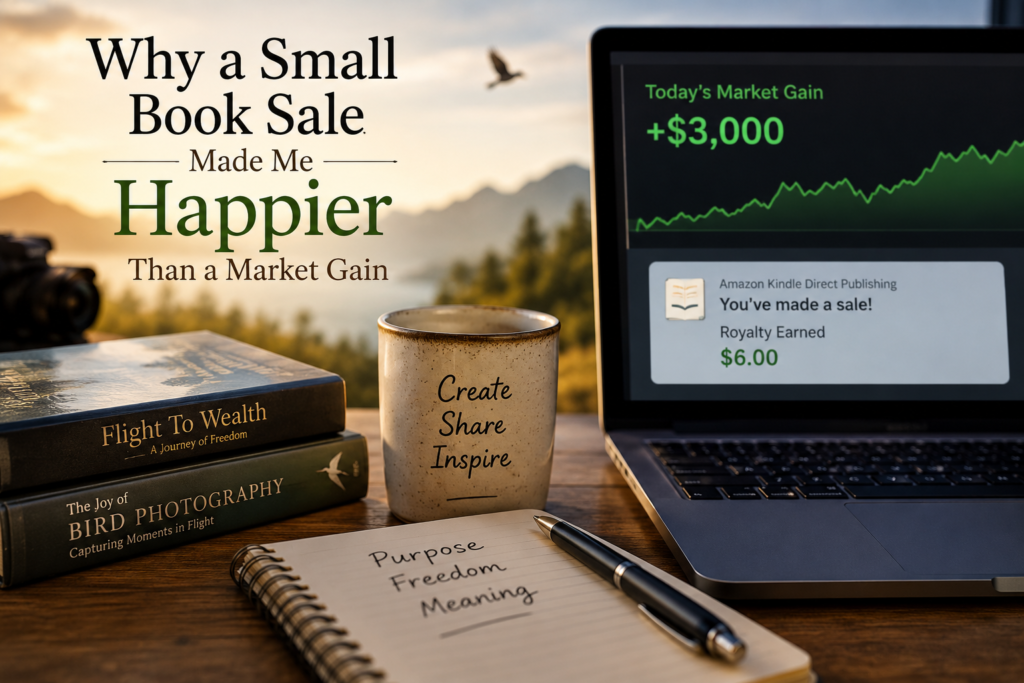
The other day, one of my books sold on Amazon. The royalty was only a few dollars—far less than what my portfolio gained that same day. Yet it was the book sale that made me smile. At first, that felt irrational. After all, money is money. If someone offered me the choice between a larger gain and a smaller one, the answer should be obvious.
But the more I thought about it, the more I realized the two gains were fundamentally different. The portfolio gain came from assets I already owned. Markets moved, prices changed, and my account balance increased. I appreciated it, but I didn’t create anything new that day. The gain was the result of capital doing what capital does.
The book sale felt different. I didn’t write the book that day. I didn’t advertise it. I didn’t even think about it until I saw the notification. Yet somewhere, someone found it, decided it was worth reading, and paid for it. A portfolio gain is automatic. A book sale is a choice someone made. That small royalty represented more than money. It represented value created in the past that was still creating value in the present.
As investors, we spend decades building financial assets. We save, invest, rebalance, and let compounding work its magic. Over time, the portfolio becomes a machine that quietly works in the background. There is nothing wrong with that. In fact, it is one of the great goals of financial independence.
But something interesting happens along the way. Once the machine is large enough, the emotional impact of another portfolio gain starts to diminish. The account grows, but your daily life doesn’t necessarily change. A book sale, a thoughtful email from a reader, a comment on an article, or appreciation for a photograph can feel surprisingly meaningful by comparison.
Why? Because those things are connected to creation rather than ownership. One comes from having capital. The other comes from having made something. Neither is better; both have value. Financial assets provide freedom, security, and independence. Creative assets provide connection, expression, and a sense that your work continues to matter after you finish it.
I suspect this is one reason many financially independent people eventually turn to writing, teaching, photography, or mentoring. After a certain point, the challenge is no longer accumulating more money. The challenge becomes creating more meaning.
The small royalty didn’t change my financial future, but it reminded me of something important: money making money is wonderful. Yet there is a unique satisfaction in seeing something you created continue to work in the world long after you finished making it.
The portfolio gain increased my net worth.
The book sale reminded me that my work still has a pulse.