
The stock market opened strongly one morning, with the S&P 500 up roughly 1%. Out of curiosity, I opened Robinhood app, and noticed there was a new prediction market feature.
One contract immediately caught my attention:
S&P 500 > 7,375 today — Yes for 89¢.
The index was already around 7,400.
At first glance, it looked almost too easy. Pay 89¢, get $1 if the market simply held its gains until the close.
A potential 11¢ profit on an 89¢ stake — about a 12% return — in a single day.
For a moment, it was tempting.
Then I thought about what would happen if I kept doing it.
The Problem With an 89¢ “Almost Certain” Win
Suppose I put $100 into a similar bet.
- Win: +$11
- Loss: −$89
The payoff is extremely asymmetric. I would need roughly eight wins just to make up for one loss.
So the real question isn’t:
“How likely am I to win?”
It’s:
“Is the probability high enough to justify the price and the risk?”
What Happens When You Repeat the Bet?
If the 89¢ price corresponds to an 89% chance of winning, then the chance of losing on any given day is about 11%.
That sounds small.
But repeated bets change the math.
The probability of experiencing at least one loss in 10 attempts is:
So there is roughly a 69% chance of encountering a loss within just ten days.
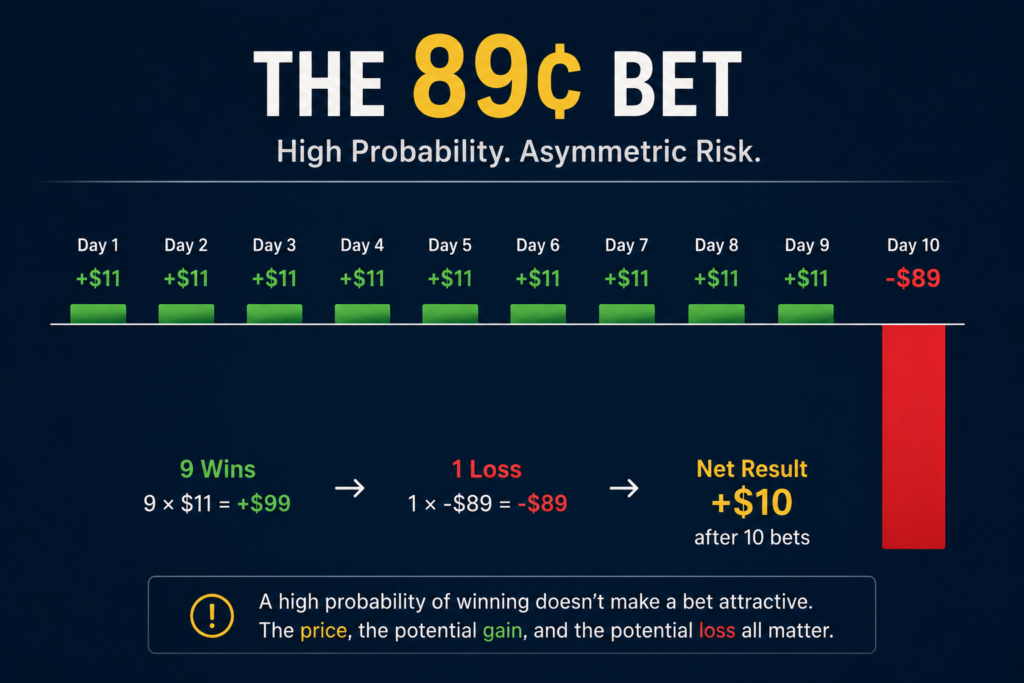
Imagine the loss doesn’t happen until Day 10:
- Day 1: +$11
- Day 2: +$11
- Day 3: +$11
- Day 4: +$11
- Day 5: +$11
- Day 6: +$11
- Day 7: +$11
- Day 8: +$11
- Day 9: +$11
- Day 10: −$89
Nine wins produce $99 of gains. One loss takes away $89.
A high probability of winning doesn’t necessarily mean a good bet.
The Break-Even Point
If I pay $89 for a chance to win $100:
- Maximum gain: $11
- Maximum loss: $89
Ignoring fees, I need to win 89% of the time just to break even.
At exactly 89%, the expected value is zero.
If the true probability is even slightly lower — say 88% — the expected value becomes negative.
The market already knows the S&P is above the threshold. The question is whether the probability is mispriced enough to give me an advantage.
There is no free 11%.
What If I Keep Reinvesting the Gains?
Now imagine I reinvest my winnings each day.
A successful day increases the next day’s stake. Another successful day increases it again.
Compounding works beautifully when the underlying investment has a positive expected return.
But compounding doesn’t care whether the bet is good or bad. It magnifies both the gains and the exposure to the eventual loss.
The longer I repeat the bet, the more likely I am to encounter that loss — and the larger the amount exposed when it happens.
That’s the difference between compounding wealth and compounding a gamble.
Playing for Fun Is Different
None of this means prediction markets are inherently bad.
There’s a difference between:
- placing a small bet for entertainment
- and trying to turn prediction markets into a strategy
If I spend $10 on a prediction because I find it interesting, that’s entertainment. If I lose it, nothing changes.
The danger is when entertainment becomes habit.
Prediction markets have a powerful psychological loop:
small win → confidence → larger bet → another win → greater risk → eventual loss → desire to win it back
At that point, the question isn’t whether one contract is attractive. It’s whether I’m being pulled into a cycle.
For me, that distinction matters:
I can afford to lose a small amount for entertainment. I don’t want to turn entertainment into a system for making money.
Why It Feels So Tempting
Prediction markets feel safe because:
- the S&P is already above the level
- the contract is cheap
- the payout is immediate
- the probability looks high
The human brain focuses on the chance of winning. It doesn’t naturally focus on the relationship between the size of the gain and the size of the loss.
The bet wasn’t interesting because it had an 89% chance of winning. It was interesting because the price already reflected that probability.
Prediction Markets vs. Building Wealth
Prediction markets can occasionally be mispriced, and skilled traders may find opportunities.
But that’s very different from buying contracts simply because they look likely to win.
Long-term wealth building is about:
- favorable expected returns
- controlled risk
- time
- compounding
- avoiding catastrophic losses
That mindset is incompatible with repeatedly making small, high‑probability bets with large downside.
The Flight to Wealth Lesson
The 89¢ contract looked like easy money.
But once I looked at the payoff rather than just the probability, it looked very different.
An investment isn’t attractive simply because it is likely to win.
Probability, price, gain, and loss all matter.
This lesson applies far beyond prediction markets — to options, speculative stocks, leveraged trades, real estate deals, businesses, and even seemingly safe investments.
The temptation is always to ask:
“How likely am I to win?”
A better question is:
“How much am I risking to find out?”
That’s one of the questions worth asking on the flight to wealth.
You Might Also Like
• When Wealth Reaches Light Speed: How Compounding Warps Time How long-term, steady investing eventually reaches a point where growth feels like financial relativity.
• The Problem With Copying a $70 Million Investing Story A reflection on why chasing someone else’s success rarely works — and how psychology shapes long‑term investing outcomes.